

How Does Bruxism (and a Night Guard) Affect Your Gums?
August 25, 2026 · Dentist Büşra KayanWaking up with jaw pain, noticing your teeth look worn down, or having a partner tell you that you grind your teeth at night — these are all familiar signs of bruxism (clenching/grinding). "Does bruxism damage the gums?" is a question I hear often from patients, but how bruxism actually affects the gums and the tissue supporting the teeth is more layered than most people assume.
In this article, I explain what bruxism is, its real effect on the gums and periodontal tissue, the nuance in the scientific evidence on this topic, and where a night guard fits into the picture.
Key Takeaways
- According to the ADA's 2021 survey, more than 70% of dentists reported noticing signs of clenching/grinding in their patients — an increase of nearly 10% over the previous year.
- Excessive occlusal force can widen the periodontal ligament around a tooth and increase tooth mobility — this is a well-documented mechanism.
- But according to a 2018 American Academy of Periodontology review, occlusal trauma does not initiate gum disease (periodontitis); the evidence that it affects disease progression is described as "weak."
- The same review also states there's no credible evidence that the "abfraction" theory causes gum recession — an important point that runs counter to a popular claim.
- The logic behind a night guard — relaxing the jaw muscles and protecting teeth from direct contact — is widely accepted, but a 2020 systematic review published in the British Dental Journal found the evidence for reduced tooth wear is still limited.
What Is Bruxism?
Bruxism is the unconscious clenching or grinding of teeth — it can happen while awake (awake bruxism) or during sleep (sleep bruxism). Most people aren't even aware they do it; often the dentist is the first to notice, spotting chipped or worn tooth surfaces.
According to a 2021 ADA survey, more than 70% of dentists reported noticing signs of clenching or grinding in their patients — a roughly 10% increase over the previous year. Stress is a common trigger, but sleep disorders, tooth alignment, and smoking/alcohol/caffeine use can also play a role.
There's a practical difference between sleep bruxism and awake bruxism: sleep bruxism typically happens with higher force and completely outside the person's awareness, so it's usually noticed by a partner, family member, or dentist rather than the person themselves. Awake bruxism, on the other hand, tends to show up as a more conscious clenching habit, giving the person a chance to notice it and intervene.
How Does Bruxism Affect the Gums and Supporting Tissue?
Continuous, excessive force on the teeth (occlusal trauma) can widen the periodontal ligament — the connective tissue between a tooth and the bone — and increase tooth mobility over time. This is a well-documented mechanism, covered in a 2018 review published in the Journal of Periodontology by the American Academy of Periodontology (Fan J, Caton JG, Journal of Periodontology, 2018;89:S214-S222).
This effect tends to be more pronounced when the gum tissue already has some degree of inflammation or weakness — healthy periodontal tissue is more resilient against excessive force than tissue that isn't healthy to begin with.
Does Bruxism Directly Cause Gum Disease?
This is where it's worth moving past the popular narrative. According to the same AAP review, occlusal trauma does not initiate periodontitis; the evidence that it affects the disease's progression is described as "weak." In other words, bruxism doesn't, on its own, "create" gum disease in otherwise healthy gums — an important distinction from a claim that gets repeated often.
The same review also questions another commonly cited mechanism: it states there's no credible evidence supporting the "abfraction" theory (small notches said to form at the tooth's neck from excessive force) as a cause of gum recession.
An older comparative study backs this up: research comparing patients with moderate-to-severe gum disease against patients presenting for bruxism found that the two conditions generally didn't co-occur closely in the same person — bone loss and tooth mobility were significantly more pronounced in the periodontal-disease group.
So Why Does Bruxism Still Matter?
None of this means bruxism is unimportant — it just means its effect works differently than "directly causing gum disease." The best-documented effects of bruxism are tooth surface wear, chipping or fracture, increased tooth mobility, and jaw joint (TMJ) pain or tension.
Also, if gum disease is already present, the extra force from bruxism can act as a modifying factor that worsens that existing picture. So the real question isn't whether bruxism matters on its own — it's whether it's layering on top of an existing gum problem.
Pain or tension in the jaw joint (TMJ) is another common effect of bruxism. Constant clenching/grinding can fatigue the muscles around the jaw joint, which can show up as morning jaw stiffness, headaches, or discomfort around the ears.
What Does a Night Guard Actually Do?
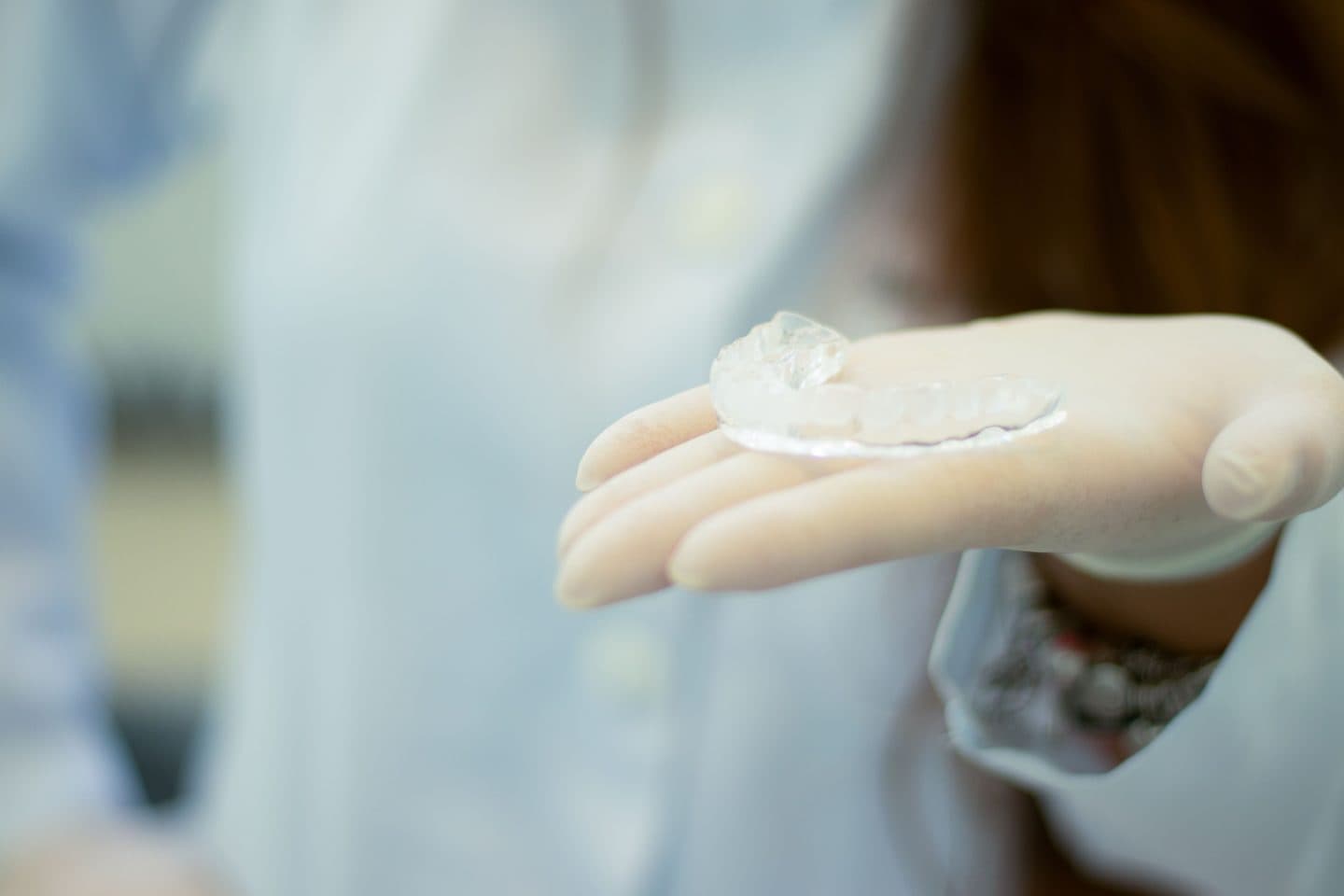
A night guard (occlusal splint) is a custom appliance placed between the upper and lower teeth that prevents them from making direct contact with each other. The idea is to redirect the force generated during grinding/clenching onto the appliance itself rather than the tooth surfaces, and to help ease tension in the jaw muscles.
Night guards generally fall into a few material categories: soft guards (a comfortable option for milder cases, though they can wear down faster in some situations), hard acrylic guards (a durable option typically used for more severe cases), and dual-laminate/hybrid guards with a soft inner layer and a hard outer layer. Which type fits your situation depends on how severe the bruxism is and your tooth/jaw structure.
The ADA recommends a custom-fitted night guard, made from a mold taken by your dentist, for the best fit and protection — over-the-counter/one-size appliances may not offer the same level of protection.
What Does the Evidence Say About How Well Night Guards Work?
Honesty matters here too: a 2020 systematic review in the British Dental Journal, examining 37 randomized controlled trials, found that the evidence for oral splints reducing tooth wear is still limited — none of the studies reviewed had directly measured tooth wear as a primary outcome (Riley P, et al., British Dental Journal, 2020;228(3):191-197).
That doesn't mean night guards don't work — it means the quality of evidence (due to study design limitations, the difficulty of blinding, and inconsistent measurement methods) is still rated "very low," and larger, better-designed trials are needed. In practice, a night guard remains a standard, commonly recommended approach because the underlying logic — physically protecting teeth from direct contact — is sound; it just shouldn't be presented as a "definitively proven" treatment, which matters for setting realistic expectations.
Is a Night Guard Enough on Its Own?
A night guard is a mechanical barrier that protects teeth from direct wear — but it doesn't address whatever is triggering the bruxism in the first place (stress, for example). According to the ADA's patient resource, stress-reduction techniques like meditation, counseling, exercise, massage, or breathing exercises can be a useful complement alongside a night guard.
That doesn't mean a night guard is unnecessary — it just means it isn't, on its own, a fix for the root cause. The best outcome tends to come from combining an approach that protects the teeth (the night guard) with one that addresses the underlying trigger.
When Should You See a Dentist?
Since bruxism so often goes unnoticed, it's hard to answer "do I have bruxism or not" with certainty on your own. But if you notice any of the following, it's worth scheduling a dental exam:
- Morning jaw pain, headaches, or discomfort around the ears
- Noticeable tooth wear, chipping, or fracture
- A partner or family member noticing you grind your teeth at night
- Increased tooth sensitivity or a feeling of looseness
- An existing gum disease diagnosis combined with any of the above
Bottom Line
Bruxism doesn't affect the gums as "directly" as the popular narrative suggests — its best-documented effects concentrate on tooth wear, mobility, and jaw pain, while its effect on gum disease itself is indirect and backed by limited evidence. A night guard rests on a sound protective mechanism and is widely recommended, but the academic evidence for its effectiveness is still a developing area.
The only way to clarify how much bruxism is affecting your specific situation, and whether a night guard is right for you, is through an exam.
Frequently Asked Questions
Does bruxism directly cause gum recession?
There's no credible evidence supporting this; a recent review also found the "abfraction" theory often cited to explain it isn't well supported.
Is wearing a night guard enough, or should I do more?
Addressing the underlying trigger of bruxism (such as stress) can also help; a night guard protects the teeth, but it's worth addressing the root cause too.
Is clenching while awake harmful too?
Yes, awake bruxism carries similar risks of wear and jaw tension; awareness and, if needed, behavioral techniques can help here.
Is a night guard recommended for every case of bruxism?
Suitability is assessed during an exam based on the condition of your teeth, jaw joint, and gums; the same approach isn't recommended for everyone.
Is a soft or hard night guard better?
This depends on how severe the bruxism is; a soft guard may be enough for mild cases, while a hard or dual-laminate guard may suit more severe cases better. The right choice is determined during an exam.
Does bruxism go away on its own?
In some cases it can ease once the trigger (like a temporary stressful period) resolves, but this isn't guaranteed; if symptoms persist, an exam is recommended.
Sources
- American Dental Association (MouthHealthy) — "Teeth Grinding"
- Fan J, Caton JG. "Occlusal Trauma and Excessive Occlusal Forces: Narrative Review, Case Definitions, and Diagnostic Considerations." Journal of Periodontology, 2018;89:S214-S222
- Riley P, Glenny AM, Worthington HV, et al. "Oral Splints for Temporomandibular Disorder or Bruxism: A Systematic Review." British Dental Journal, 2020;228(3):191-197