

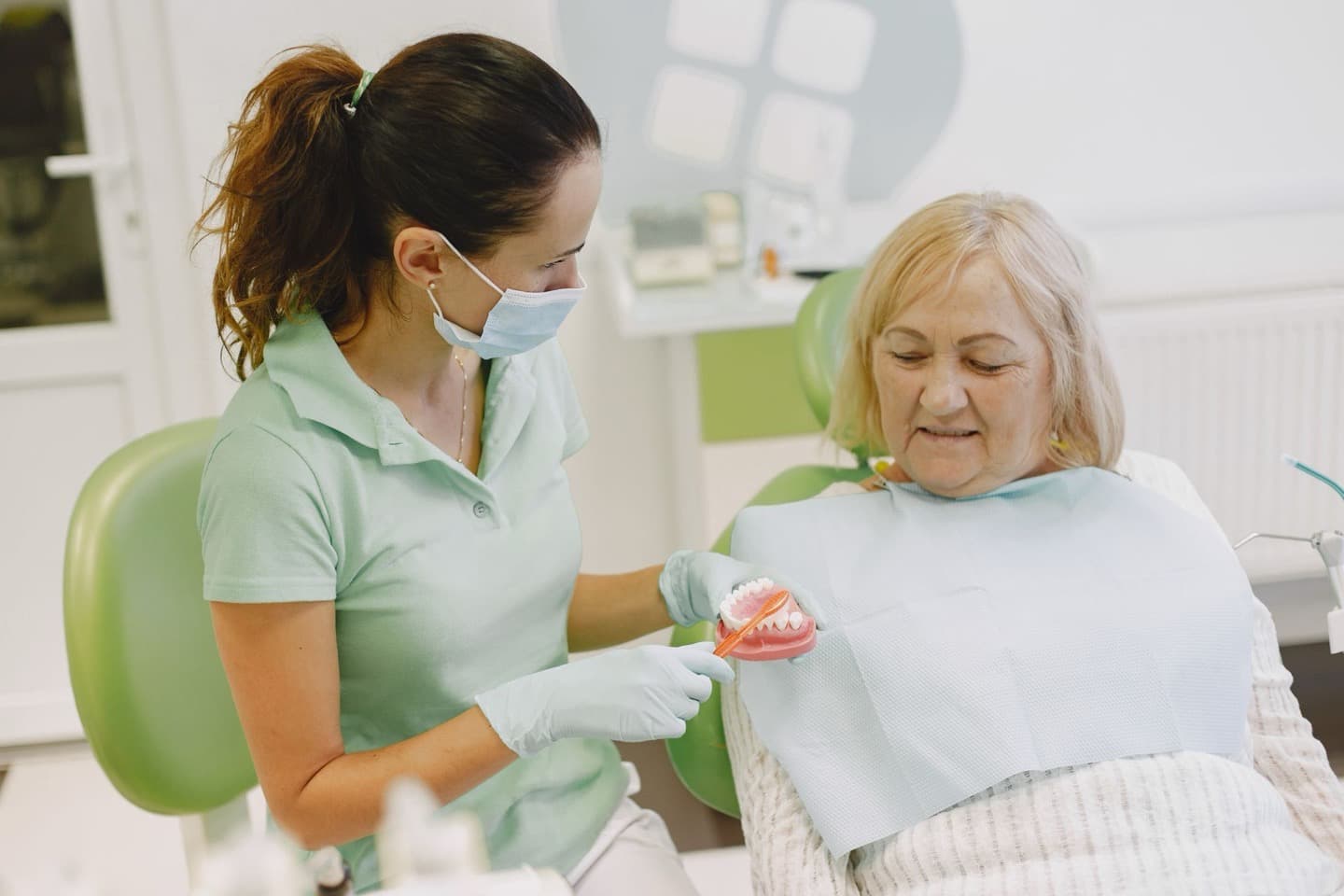
When you've lost a tooth, there's no single right answer to "dentures or implants" — the decision depends on your bone structure, your general health, and how much daily maintenance you're able to manage.
This article walks through the evidence-based criteria that shape this decision — bone structure, systemic health, daily care capacity — and compares the two options in a practical table. As a dentist serving the Eyüpsultan, Kemerburgaz, and Göktürk area, nearly every patient of mine who has lost a tooth ends up weighing these two options.
Key Takeaways
- Implant survival varies by jaw location: 99.0% in the mandible versus 92.8% in the maxilla, where bone quality is generally lower (Ali Hassan et al., 2026).
- Low bone density alone doesn't rule out implants — with special techniques, the survival difference versus normal bone density becomes statistically insignificant after 5 years (Radi et al., 2018).
- Manual dexterity, daily hygiene capacity, and general health can matter as much as bone structure.
- Fixed (implant-supported) solutions outperform dentures on chewing efficiency and quality-of-life measures, but that doesn't automatically make them "better" for every patient.
- Which option actually fits you can only be decided after a full exam and imaging.
How Do Dentures and Implants Work?
A denture is a removable set of artificial teeth that rests on the gums; it has no direct connection to the jawbone (ADA MouthHealthy, "Dentures," retrieved 2026-08-25). An implant, by contrast, is a restoration fixed onto a titanium post surgically placed in the jawbone, fusing with the bone (osseointegration) to form a permanent structure (ADA MouthHealthy, "Implants," retrieved 2026-08-25).
This basic difference underlies every decision criterion that follows: dentures can be fitted regardless of bone volume, while implant success depends directly on the volume and quality of the bone available.
How Does Bone Structure Affect the Decision?
A recent systematic review published in Cureus shows that bone quality varies by jaw and directly affects implant survival: survival is 99.0% in the mandible, while in the maxilla — where bone quality is generally lower — it drops to 92.8% (Ali Hassan MA, Elhadi RM, Osman M, et al., "Choosing Between Fixed and Removable Prosthetic Modalities for Completely Edentulous Patients: A Systematic Review of Evidence-Based Outcomes," Cureus, 2026;18(1):e101213, retrieved 2026-08-25).
But the assumption "my bone density is low, so implants are off the table" isn't quite right either. A meta-analysis covering 11 studies and 1,071 participants found no significant difference in implant survival between patients with low and normal bone density five years after placement — with special surgical techniques and careful planning, similar outcomes can be achieved even with lower bone density (Radi IA-W, Ibrahim W, Iskandar SM, AbdelNabi N, "Prognosis of Dental Implants in Patients With Low Bone Density: A Systematic Review and Meta-Analysis," Journal of Prosthetic Dentistry, 2018;120(5):668-677, retrieved 2026-08-25). In other words, low bone density doesn't automatically disqualify someone from implants — that's a detail to evaluate after imaging.
What Difference Do General Health and Age Make?
According to Ali Hassan et al.'s review, systemic health status and a patient's ability to maintain oral hygiene — particularly for elderly or medically compromised patients — play a decisive role in treatment selection (ibid.). Factors like uncontrolled diabetes and smoking can complicate implant healing, which may call for additional evaluation before treatment.
Age itself isn't an automatic barrier to implants — but the health conditions that often come with it, and one's capacity to manage the healing process, are a meaningful part of the decision.
Why Do Daily Care and Habits Matter?
The same review emphasizes that patient-related factors — expectations, manual dexterity, motivation, psychosocial support — significantly influence adaptation and satisfaction (Ali Hassan et al., ibid.). Fixed, implant-supported solutions require a more demanding hygiene routine, while removable dentures are easier to clean for patients with limited manual dexterity.
That's why "which is better" doesn't have a single answer — your daily care capacity and habits can matter as much as the medical factors.
Comparison: Which Option May Suit Whom?
Putting the evidence above together, here's how the two compare:
| Criterion | Dentures | Implants |
|---|---|---|
| Bone requirement | Not dependent on bone structure | Requires adequate bone volume/quality; low density can sometimes be offset with special technique |
| Daily maintenance | Removable and easy to clean; suits patients with limited dexterity | Fixed structure, brushed like natural teeth but needs a more thorough hygiene routine |
| Chewing efficiency | More limited than natural teeth | Closer to natural teeth; higher quality-of-life scores in studies |
| Surgical procedure | Not required | Required; a general health evaluation is a precondition |
Bottom Line
There's no single right answer to dentures versus implants — it comes down to your bone structure, your general health, and your daily care capacity together. Even if your bone density is low, that doesn't automatically rule out implants — but that can only become clear after imaging and an exam.
Frequently Asked Questions
Can implants be placed at any age?
Age itself isn't a barrier; what matters is the health conditions that often accompany it and your capacity to manage the healing process.
If my bone density is low, do I have no chance at implants?
No — research shows special techniques can achieve implant survival rates similar to normal bone density even when density is low; the actual assessment happens after imaging.
Can you switch from dentures to implants later?
In most cases yes, but that's also a decision made after an exam of your bone condition and general health.
Sources
- Ali Hassan MA, Elhadi RM, Osman M, Abdalrahman SA, Eltahir MA, Nureldinn S. "Choosing Between Fixed and Removable Prosthetic Modalities for Completely Edentulous Patients: A Systematic Review of Evidence-Based Outcomes." Cureus, 2026;18(1):e101213
- Radi IA-W, Ibrahim W, Iskandar SM, AbdelNabi N. "Prognosis of Dental Implants in Patients With Low Bone Density: A Systematic Review and Meta-Analysis." Journal of Prosthetic Dentistry, 2018;120(5):668-677
- American Dental Association (MouthHealthy) — "Implants"
- American Dental Association (MouthHealthy) — "Dentures"