

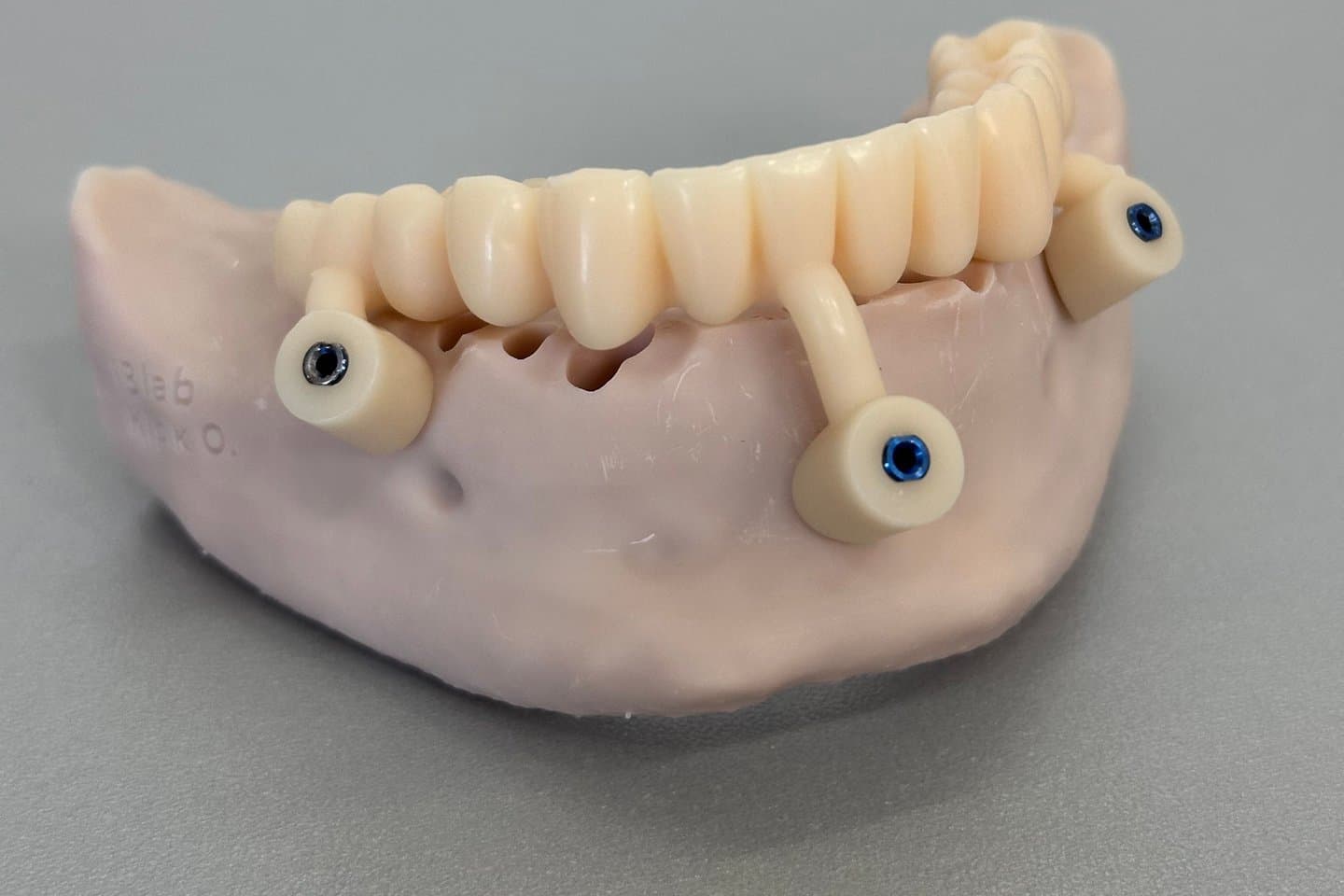
"Get an implant so your jawbone doesn't erode" — you've probably heard this from someone or read it somewhere online. It's true that jawbone loss does happen after tooth loss, and implants do play a role in that process. But "fully stops it" is a claim my patients often perceive as a more certain guarantee than it actually is.
In this article, I explain why bone loss happens, where and how much an implant slows that process down, where it doesn't, and what the scientific literature actually says about it.
Key Takeaways
- Bone loss in the jaw after tooth loss results from the bone losing functional loading (chewing force); this process begins naturally after extraction.
- An implant can help protect bone by partially restoring functional loading to that area through osseointegration — but that doesn't mean it "fully stops" bone loss.
- A 2022 study found that even in implants considered successful, measurable bone loss (around a 0.5 mm threshold) in the first 6 months after loading is an expected, normal process.
- A large 2025 systematic review covering 102 studies found that, on a per-patient basis, 46% of implant patients developed peri-implant mucositis and 21% developed peri-implantitis — an inflammatory disease that can cause progressive bone loss around an implant.
- Patients with a history of periodontal disease face a higher risk of bone loss around implants.
- An implant only affects the bone in the area where it's placed; it doesn't prevent bone loss elsewhere in the jaw.
The Part of the Claim That's Partly True
It's worth saying upfront that this claim isn't entirely baseless — there's a real biological mechanism behind it. Like other bones in the body, the jawbone stays alive through the functional load (chewing force) placed on it; when a tooth is lost, the bone in that area no longer receives that signal, normally transmitted through the periodontal ligament, and begins to lose volume (resorb) over time. According to the American Dental Association's (ADA) patient resource, if a lost tooth isn't replaced promptly with a graft or an implant, the jawbone develops atrophy over time, and bone in areas left toothless for a long period can become too thin to safely support an implant (ADA MouthHealthy, "Implants," retrieved 2026-08-25).
Behind this mechanism is a general biological principle of bone: bone tissue remodels itself according to the mechanical load placed on it — bone that isn't loaded enough loses mass over time, while regularly loaded bone maintains its density. When a tooth is extracted, the chewing signal transmitted to the bone through that tooth's periodontal ligament also disappears; the bone starts to resorb because it no longer receives that signal.
An implant fuses directly to the jawbone through osseointegration and transmits a functional load back to that area during chewing. In theory, this is a mechanism that fills the gap left by the natural tooth and keeps the bone "stimulated" in that area. The part of the claim that says "an implant doesn't let the bone be completely forgotten" rests on a reasonable premise in that sense.
So Does an Implant Reduce Bone Loss to Zero?
No — and this is where the claim starts to part ways with reality. A 2022 study published in Clinical Implant Dentistry and Related Research shows that even in implants considered "successful," some level of bone loss is normal and expected. The researchers found that bone loss exceeding 0.5 mm in the first 6 months after loading increases the risk that an implant will no longer be considered radiographically "successful" (Galindo-Moreno P, Catena A, Pérez-Sayáns M, et al., "Early Marginal Bone Loss Around Dental Implants to Define Success in Implant Dentistry: A Retrospective Study," Clinical Implant Dentistry and Related Research, 2022;24(5):630-642, retrieved 2026-08-25).
In other words, bone loss isn't zero even in the best-case scenario — some bone loss is expected in the early period after loading, and it slows down afterward. The claim that an implant "fully stops" bone loss overlooks this natural, measured remodeling process.
The same study also found that implants with a prosthetic abutment of 2 mm or longer showed significantly less bone loss than those with shorter abutments. That shows the question "how much bone loss will there be" doesn't have a single answer — the implant's technical design also affects the outcome.
Peri-Implantitis: The Real Driver of Risky Bone Loss
The most significant cause of bone loss around an implant isn't actually the implant itself — it's an inflammatory disease that can develop around it: peri-implantitis. You can think of it as the implant equivalent of periodontitis in natural teeth — inflammation that starts in the soft tissue around the implant and, if untreated, progresses and erodes the bone holding the implant in place.
A large 2025 systematic review and meta-analysis published in the Journal of Periodontology, covering 102 studies, found that on a per-patient basis 46% (95% CI, 41%-51%) of implant patients developed peri-implant mucositis, and 21% (95% CI, 17%-24%) developed peri-implantitis (Galarraga-Vinueza ME, et al., "Prevalence, Incidence, Systemic, Behavioral, and Patient-Related Risk Factors and Indicators for Peri-Implant Diseases: An AO/AAP Systematic Review and Meta-Analysis," Journal of Periodontology, 2025;96:587-633, retrieved 2026-08-25). These figures matter because the claim that "an implant stops jawbone loss" ignores the fact that the implant itself can become a new source of bone loss.
Who Is at Higher Risk?
A 2025 literature review examined the various biological and technical factors affecting bone loss around implants and noted that early bone loss can be a signal predicting later development of peri-implantitis (Arai Y, Takashima M, Matsuzaki N, Takada S, "Marginal Bone Loss in Dental Implants: A Literature Review of Risk Factors and Treatment Strategies for Prevention," Journal of Prosthodontic Research, 2025;69(1):12-20, retrieved 2026-08-25).
The 2025 AO/AAP (Academy of Osseointegration / American Academy of Periodontology) consensus on the same topic points to similar risk factors: smoking, uncontrolled diabetes (high HbA1c), and a history of periodontal disease significantly increase the risk of peri-implant bone loss (Galarraga-Vinueza et al., ibid.). For a patient who lost teeth to periodontal disease, an implant doesn't provide automatic protection — on the contrary, this patient group needs closer monitoring for peri-implantitis.
It's worth briefly explaining why these risk factors matter. Smoking reduces blood flow in the gums, both delaying healing and weakening the immune system's inflammatory response — which lets peri-implantitis progress unnoticed. Uncontrolled diabetes similarly impairs tissue healing and resistance to infection through elevated blood sugar. A history of periodontal disease is explained by a higher likelihood that the patient's oral flora already contains the bacterial species associated with peri-implantitis.
The Implant's Reach: Only Its Own Site
An implant only transmits functional load to the bone where it's placed — if you have a missing or at-risk tooth elsewhere in your mouth, an implant elsewhere won't prevent bone loss there. Likewise, general bone density loss from systemic causes like osteoporosis falls outside an implant's reach.
That's why it would be misleading to conclude "I got an implant, so my jawbone is now safe." An implant is a solution limited to the area it treats; the rest of your oral health needs its own separate evaluation and care.
Ways to Limit Bone Loss Risk
The findings above aren't meant to paint a bleak picture — they're meant to set a realistic expectation. The good news: peri-implant bone loss risk isn't entirely out of your hands. The AO/AAP consensus emphasizes that quitting or reducing smoking, keeping diabetes tightly controlled, and keeping up with regular supportive care (professional cleanings and checkups) are among the most effective approaches to reducing bone loss risk.
In short, an implant isn't a solution that "eliminates bone loss in a single procedure" — it's a long-term outcome that needs to be supported by proper care. In practice, that means not skipping follow-up appointments after getting an implant. Peri-implant mucositis — the early, reversible stage of inflammation around the implant that hasn't yet reached the bone — can be caught and managed through regular checkups before it progresses to peri-implantitis.
Bottom Line: What an Implant Stops, and What It Doesn't
To bring everything together:
| Situation | The Implant's Effect |
|---|---|
| Loss of functional load in that area after tooth loss | Partially restored via osseointegration, supporting the bone |
| Normal bone remodeling in the early period after loading | Not stopped — a certain level is expected and considered normal |
| Progressive bone loss caused by peri-implantitis | Not prevented — this is a separate risk the implant itself can create |
| Bone loss from tooth loss elsewhere in the mouth | Not affected — the implant is limited to its own site |
| Bone density loss from systemic causes like osteoporosis | Not affected — outside the implant's reach |
Conclusion: It Helps, But It's Not a Guarantee
The honest answer to "does an implant fully stop bone loss" is: it helps, partially, but not fully or with a guarantee. Through osseointegration, an implant can restore functional load to the bone in its own area and slow down bone loss there — but that doesn't mean zero bone loss or complete immunity from peri-implantitis risk.
The long-term health of your bone depends as much on your regular checkups and care as it does on the implant itself. Only an exam can clarify your specific risk factors and how your post-implant follow-up plan should be shaped.
Frequently Asked Questions
Will I have zero bone loss after getting an implant?
No — even in implants considered successful, some bone loss in the early period after loading is normal; what matters is that it doesn't exceed a certain threshold.
What is peri-implantitis, and can it cause implant failure?
Peri-implantitis is an inflammatory disease that develops in the tissue around an implant and, if untreated, can erode the bone holding the implant in place; in advanced cases it can lead to implant loss.
I had periodontal disease — is an implant still safe for me?
A history of periodontal disease raises the risk of peri-implant bone loss, but that doesn't mean an implant can't be done; it calls for closer follow-up and regular care. Suitability is decided after an exam.
How is bone loss around an implant detected?
It's monitored through regular checkups and, when needed, X-ray imaging — which is why keeping up with post-implant follow-up appointments matters.
Does an implant prevent bone loss in my other teeth too?
No — an implant only affects the bone where it's placed; it doesn't prevent bone loss elsewhere in the mouth.
What can I do to reduce the risk of bone loss?
Quitting or reducing smoking, keeping diabetes under control if you have it, and not skipping regular dental checkups are among the approaches considered effective at reducing risk.
Are peri-implant mucositis and peri-implantitis the same thing?
No. Mucositis is an early, reversible stage of inflammation confined to the soft tissue around the implant that hasn't yet reached the bone; peri-implantitis is the stage where that inflammation has progressed into the bone and is causing bone loss.
Sources
- American Dental Association (MouthHealthy) — "Implants"
- Galindo-Moreno P, Catena A, Pérez-Sayáns M, et al. "Early Marginal Bone Loss Around Dental Implants to Define Success in Implant Dentistry: A Retrospective Study." Clinical Implant Dentistry and Related Research, 2022;24(5):630-642
- Arai Y, Takashima M, Matsuzaki N, Takada S. "Marginal Bone Loss in Dental Implants: A Literature Review of Risk Factors and Treatment Strategies for Prevention." Journal of Prosthodontic Research, 2025;69(1):12-20
- Galarraga-Vinueza ME, et al. "Prevalence, Incidence, Systemic, Behavioral, and Patient-Related Risk Factors and Indicators for Peri-Implant Diseases: An AO/AAP Systematic Review and Meta-Analysis." Journal of Periodontology, 2025;96:587-633