

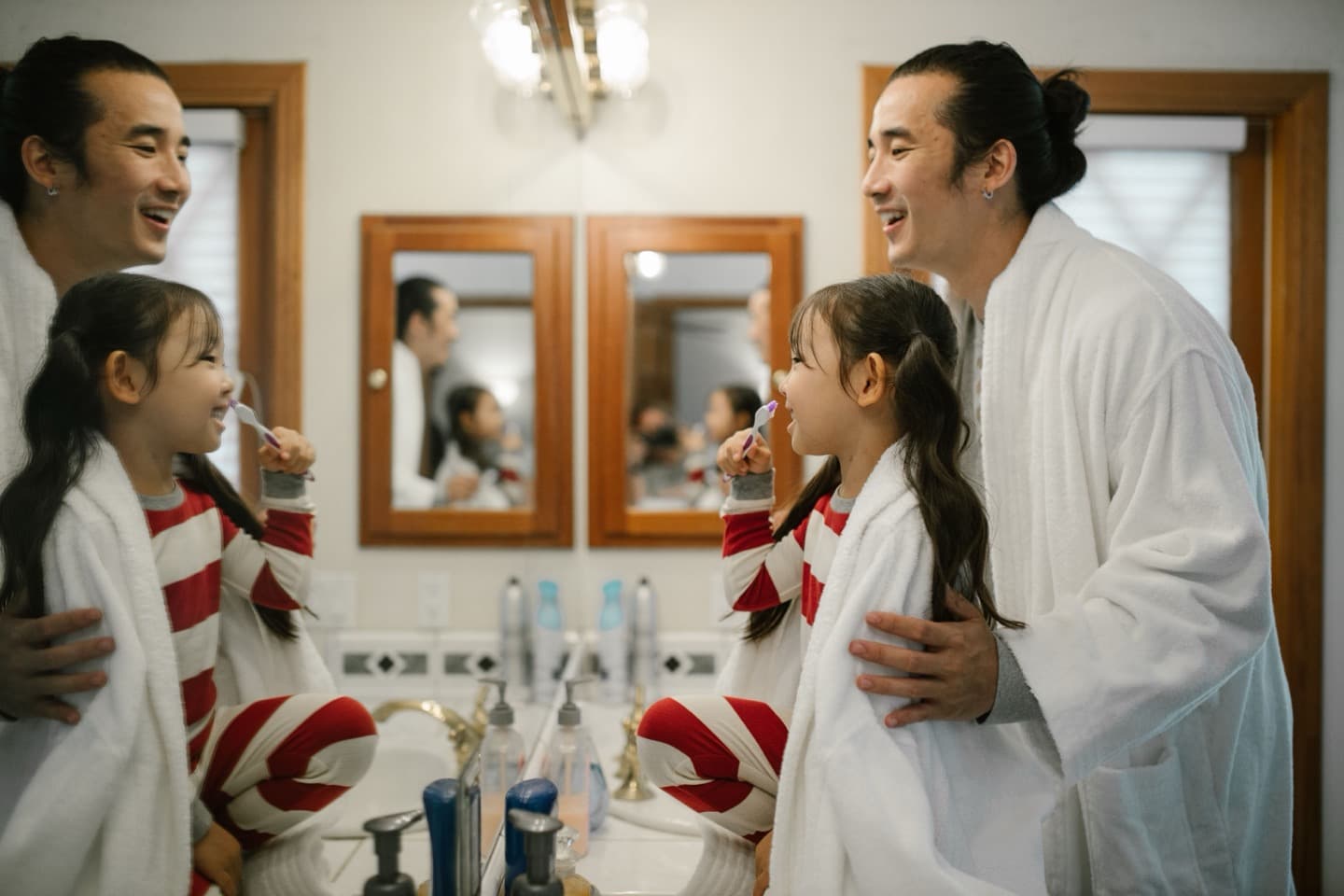
Is Tooth Sensitivity Different in Children and Adults?
August 31, 2026 · Dentist Büşra KayanFeeling a sudden zing in a tooth while drinking something cold or eating ice cream is a common complaint in both children and adults. But the underlying cause usually isn't the same in both groups — and knowing the difference makes it easier to know what to do about it, and when.
In this article, I explain the mechanism behind tooth sensitivity, molar-incisor hypomineralization (MIH) — a condition often seen in newly erupted teeth in children — the gum recession and enamel wear more common in adults, and the findings of a recent study comparing the two groups, based on guidance from the American Dental Association (ADA) and the American Academy of Pediatric Dentistry (AAPD).
Key Takeaways
- Tooth sensitivity happens when the protective enamel or cementum layer is damaged, exposing the dentin tubules underneath (ADA).
- In children, one significant cause of sensitivity is MIH (molar-incisor hypomineralization), an enamel mineralization defect that can appear in newly erupted permanent teeth.
- A 2021 study found that MIH-related sensitivity was more severe in children under 8, and 5.49 times more common in molars than in incisors.
- In adults, the most common causes of sensitivity include gum recession, decay, cracked teeth, worn fillings, and gum disease (ADA).
- Which cause applies to you or your child can only be determined after a dental exam.
What Is Tooth Sensitivity, and Why Does It Happen?
According to the ADA's patient guidance, when a tooth's outer protective layers — enamel and, on the root surface, cementum — are damaged, the dentin underneath becomes exposed. Dentin contains microscopic channels called tubules, which allow hot, cold, or acidic/sugary stimuli to reach the nerve inside the tooth (ADA MouthHealthy, "Sensitive Teeth," retrieved 2026-08-31).
So sensitivity isn't a "malfunction" in the tooth — it's a symptom that appears once a protective layer has thinned out or disappeared. What causes that protective layer to disappear, though, differs noticeably between children and adults — and that difference is what this article is really about.
In practice, this means two patients can both describe "my tooth is sensitive" and be dealing with completely different clinical pictures: one might have an enamel structure issue in a newly erupted molar, the other might be dealing with gum recession that's progressed over years. Both get called "sensitivity," but the underlying cause — and the management — differs.
Sensitivity in Children: What Is MIH (Molar-Incisor Hypomineralization)?
According to the AAPD's official definition, MIH is a qualitative defect in the enamel of both primary and permanent teeth; the affected enamel is insufficiently mineralized, making it more porous and fragile than normal (AAPD, "Molar-Incisor Hypomineralization," The Reference Manual of Pediatric Dentistry, adopted 2024, retrieved 2026-08-31).
This means sensitivity in children isn't always about gradual wear the way it often is in adults — it can stem from an enamel structure difference that's already present the moment the tooth erupts. In other words, some children notice sensitivity almost immediately in a newly erupted tooth.
The AAPD notes that MIH can be visually identified as white-yellow or yellow-brown discoloration on the tooth, and in more severe cases, the affected enamel can chip or break down over time (AAPD, ibid.). If you notice this kind of discoloration or surface irregularity on your child's newly erupted molar, it's worth treating as a finding to have evaluated at an exam rather than dismissing it as a random stain.
Why Are Molars More Sensitive?
A study published in Scientific Reports in 2021 examined MIH-related sensitivity and turned up two striking findings: sensitivity was notably more severe in children under age 8, and it was 5.49 times more common in molars than in incisors (Linner T, Khazaei Y, Bücher K, et al. "Hypersensitivity in Teeth Affected by Molar-Incisor Hypomineralization (MIH)." Scientific Reports, 2021;11:17434, retrieved 2026-08-31).
The researchers attribute this to the affected enamel's reduced mineral density and increased porosity, which weakens the tooth's thermal insulation and can lead to earlier dentin exposure. The practical takeaway: if a child describes noticeable cold sensitivity specifically in their back (molar) teeth, that's not necessarily a coincidence.
It's also worth noting that molars carry the bulk of chewing load — which can set already-fragile MIH-affected enamel up for faster breakdown under functional stress. That's why early diagnosis in a child with suspected MIH matters not just for managing sensitivity, but for preventing further structural damage to the tooth.
Sensitivity in Adults: Gum Recession and Enamel Wear
According to the ADA, the most common causes of sensitivity in adults include tooth decay, cracked teeth, worn fillings, and gum disease. When gums recede, the root surface — normally covered by gum tissue — becomes exposed, making that area more vulnerable to sensitivity (ADA MouthHealthy, ibid.).
So in adults, sensitivity typically shows up at the end of a cumulative process — gradual wear or gum loss over time — rather than at the moment a tooth erupts, as it can with MIH in children.
This cumulative nature also means sensitivity in adults is often noticed more slowly: mild sensitivity can build gradually over months, and people sometimes write it off as "a normal part of aging" and ignore it for a long time. But underneath it there could be decay or progressing gum disease — both manageable with early intervention.
Comparison: Child or Adult?
Putting the two pictures side by side clarifies which cause is more likely in which age group:
| Feature | Typical Picture in Children | Typical Picture in Adults |
|---|---|---|
| Common cause | MIH (enamel mineralization defect) | Gum recession, enamel wear |
| Onset timing | As soon as the tooth erupts | Gradually, with cumulative wear |
| Most affected tooth | Molars (5.49x more common) | Any tooth with gum recession |
| Typical age | More severe under age 8 | Variable, usually later in life |
Is There a Connection to Baby Tooth Decay?
There's another possible cause of sensitivity: decay itself. As I explained in "Is Baby Tooth Decay Really Unimportant?", untreated decay can also expose dentin, leading to sensitivity (and later, pain). So sensitivity in a child doesn't have to be MIH — decay is another possibility.
That brings up a practical point: when you notice sensitivity in your child, the answer to "is this MIH, decay, or just a normal process" only becomes clear after an exam — not by trying to figure it out yourself.
One practical difference between the two: decay-related sensitivity is usually localized to a single tooth, where the decay is; MIH-related sensitivity can appear symmetrically across multiple molars or incisors. That's not a self-diagnosis method, though — just an observation that can help you know what to ask about at the exam.
Does Toothpaste or At-Home Care Help With Sensitivity?
In both children and adults, regular brushing with the correct technique helps prevent further wear to the tooth's existing protective structure. Sensitivity-specific toothpastes aim to ease the symptom by blocking dentin tubules or temporarily reducing nerve signal transmission.
These products don't remove the underlying cause, though — they manage the symptom. If there's a structural enamel issue from MIH, or advanced gum recession, a dentist's evaluation is needed for a lasting fix.
Choosing a sensitivity toothpaste for a child requires an extra consideration adults don't need to worry about as much — an age-appropriate fluoride amount — so it's safer to ask your dentist which product fits your child rather than deciding on your own.
When Does Sensitivity Need an Exam?
Occasional, mild, short-lived sensitivity — triggered by something very cold or hot, for example — usually isn't an emergency. But in the following cases, it's safer to schedule an exam without waiting:
- Can wait: mild sensitivity that only appears with a very cold or hot trigger and passes within seconds
- Needs a prompt exam: persistent or recurring sensitivity, sensitivity that interferes with daily eating or drinking, pain concentrated in a specific tooth
- Extra attention in children: discoloration, surface roughness, or noticeable sensitivity on a newly erupted molar
Bottom Line
Tooth sensitivity can't be reduced to a single cause, and the picture in children usually has a different root than the picture in adults: in children, it's often tied to enamel mineralization structure (MIH); in adults, it's more often tied to wear or gum recession that builds up over time. In either case, the only reliable way to identify the actual cause behind the sensitivity is a dental exam.
Frequently Asked Questions
My child's tooth is very sensitive to cold — is that normal?
Mild, occasional sensitivity is common, but noticeable or recurring sensitivity can point to a cause like MIH or decay; it's worth having it evaluated at an exam.
Can MIH be treated?
MIH itself is a difference in enamel structure; its management (such as fluoride application or a protective filling) is planned by the dentist based on the affected tooth's condition.
Does sensitivity in adults go away on its own?
Depending on the cause, some mild sensitivity may ease over time, but sensitivity from gum recession or enamel wear usually doesn't resolve on its own; a dentist's evaluation is recommended.
Can sensitivity be mistaken for decay?
Yes — since both sensitivity and decay can involve exposed dentin, the reliable way to tell them apart is a dental exam.
Sources
- ADA MouthHealthy — "Sensitive Teeth"
- AAPD — "Molar-Incisor Hypomineralization" (The Reference Manual of Pediatric Dentistry, adopted 2024)
- Linner T, Khazaei Y, Bücher K, Pfisterer J, Hickel R, Kühnisch J. "Hypersensitivity in Teeth Affected by Molar-Incisor Hypomineralization (MIH)." Scientific Reports, 2021;11:17434