

Many parents aren't sure when to take their child to the dentist for the first time — some plan to wait "until all the teeth are in," some think age 3, and some wait until a problem shows up. But international guidance on this has pointed in one clear direction for a while now, and it's earlier than most parents expect.
In this article, I explain when the first dental visit should happen, why baby teeth matter, what actually happens at that first visit, and why the idea that "it's just a baby tooth, it'll fall out anyway" can be misleading — based on current guidance from the American Academy of Pediatric Dentistry (AAPD), the UK's NHS, and Turkey's Ministry of Health.
Key Takeaways
- The AAPD, ADA, and NHS all recommend the same window: a child's first dental visit should happen within 6 months of the first tooth erupting, and no later than their first birthday.
- Baby teeth aren't just placeholders — they support proper nutrition, normal speech development, and guide permanent teeth into the right position as they erupt.
- The point of the first visit usually isn't treatment; it's a brief exam, a risk assessment, and preventive guidance for parents.
- Early childhood caries (commonly called "baby bottle tooth decay") can progress quickly — dismissing decay in a baby tooth as unimportant because "it'll fall out anyway" can be misleading.
- The right care plan and visit frequency for your child can only be determined after an in-person exam.
What's the Right Time for the First Dental Visit?
The American Academy of Pediatric Dentistry (AAPD) recommends establishing a "dental home" — a dentist who provides ongoing, continuous care — within 6 months of the first tooth erupting, and no later than the child's first birthday (AAPD, "Policy on the Dental Home," retrieved 2026-08-31). The American Dental Association (ADA) and the American Academy of Pediatrics (AAP) share this same recommendation.
The UK's NHS follows the same guidance: babies should see a dentist once their first tooth appears, or by their first birthday at the latest — for most babies, that falls somewhere between 6 and 10 months (NHS, "Looking after your baby's teeth," retrieved 2026-08-31). Turkey's Ministry of Health guidance on children's oral health also states that dental care should begin during the 6-8 month window when the first teeth appear (T.C. Ministry of Health, "Oral and Dental Health in Children," retrieved 2026-08-31) — three independent sources, all pointing to the same window.
This represents a real shift from the older, once-common practice of waiting until age 3. According to the AAPD's own technical review, delaying preventive care until age 3 is often already too late for children at higher risk of decay (AAPD, "The Importance of the Age One Dental Visit").
Why Do Baby Teeth Matter So Much?
Baby teeth are often dismissed as temporary, but they serve three concrete functions. According to Turkey's Ministry of Health guidance, baby teeth (1) support proper nutrition, (2) are necessary for normal speech development, and (3) guide permanent teeth into the correct position as they erupt (T.C. Ministry of Health, ibid.).
That third function is easy to overlook: if a baby tooth is lost early or badly damaged by decay, the permanent tooth developing underneath can come in misaligned. In other words, baby tooth health isn't just about now — it affects the permanent bite that comes later.
Why Not Wait? The Benefits of an Early Visit
The point of an early visit isn't to treat a problem — it's to prevent one from developing. According to the AAPD's assessment, early dental visits can help prevent unnecessary suffering and reduce the likelihood of needing more extensive surgical or emergency dental treatment later on (AAPD, "The Importance of the Age One Dental Visit").
There's also a habit-forming benefit: a child who gets used to short, low-stress visits early on is less likely to develop dental anxiety later in life. The NHS frames the purpose of early visits as "prevention, familiarisation, and practical advice for parents" (NHS, ibid.) — meaning the first few visits are mostly about the child getting comfortable with the sights, sounds, and environment of a dental clinic.
What Actually Happens at the First Visit?
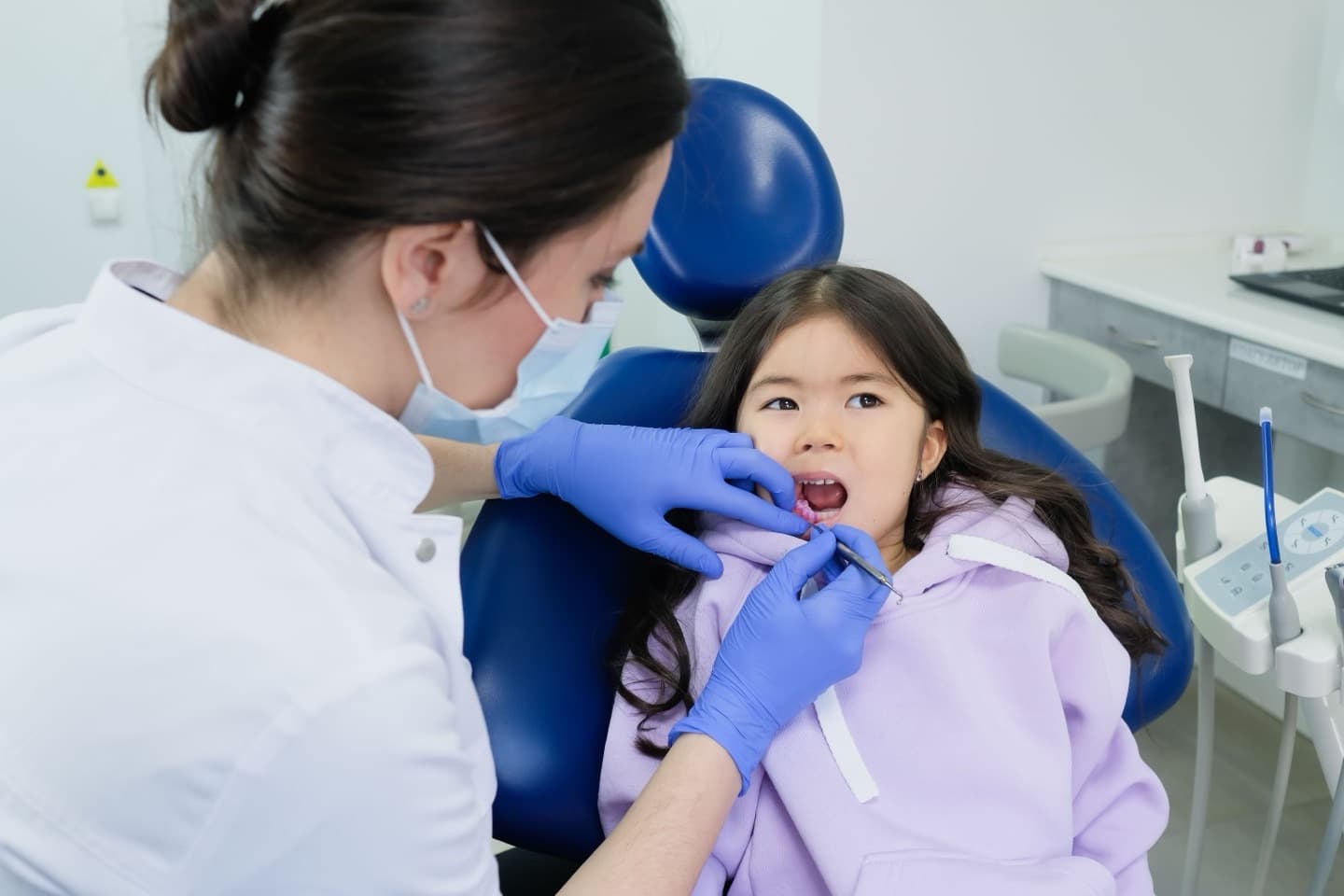
The first visit is usually brief. According to the AAPD, the dentist performs a short oral exam, provides preventive oral health guidance, demonstrates home care techniques for the parent, and offers guidance suited to the child's development (AAPD, "Policy on the Dental Home").
The NHS describes babies and young children as often sitting on a parent's lap or in their arms, in whatever position is most comfortable — the goal isn't to push the child through a procedure, but to help them get used to the sights, sounds, and smells of the clinic (NHS, ibid.). In practice, that means the first visit is closer to an introduction and information session than an intensive procedure.
What Is Early Childhood Caries ("Baby Bottle Tooth Decay")?
Many parents don't take a cavity in a baby tooth seriously, reasoning that "it's going to fall out anyway." But Turkey's Ministry of Health guidance flags exactly this: early childhood caries (commonly known as "baby bottle tooth decay") can progress quickly — the guidance notes that brown spots can appear on teeth almost as soon as they erupt, and that these teeth can chip or break down entirely (T.C. Ministry of Health, ibid.).
This type of decay is especially associated with prolonged bottle contact — particularly overnight, with sugary liquids. An untreated baby tooth cavity can lead to pain, infection, and (as covered in the previous section) can affect the permanent tooth developing underneath it — so "it'll fall out anyway" doesn't make a baby tooth cavity unimportant.
When and How Should At-Home Dental Care Start?
According to Turkey's Ministry of Health guidance, cleaning should begin when a baby is 6-8 months old — that is, as soon as the first teeth appear in the mouth (T.C. Ministry of Health, ibid.). In other words, at-home care isn't something to postpone until "all the teeth are in" — it starts from the moment the first tooth erupts.
At the first dental visit, your dentist will show you the brushing technique and amount of toothpaste appropriate for your child's age — so that first visit is informative not just for your child, but for you as a parent, too.
Pediatric Dentist or General Dentist?
Both general dentists and dentists who specialize in pediatric dentistry can provide basic preventive and restorative care for children. Pediatric dentists complete additional training beyond dental school specifically focused on treating children.
Which approach fits your child better — for example, whether a referral to a pediatric specialist makes sense for a child with significant anxiety, a specific health condition, or more extensive treatment needs — is something you can discuss with your dentist at the first exam.
Bottom Line: When to Book
In short: meeting a dentist within 6 months of your child's first tooth erupting, and no later than their first birthday, is the shared recommendation across three independent international and national guidelines. That first visit isn't a treatment — it's a chance for your child to get comfortable with the clinic and for you to get concrete guidance on at-home care. The right care plan for your child becomes clear only after an in-person exam.
Frequently Asked Questions
My child's first tooth hasn't come in yet — should I still go?
Yes — guidance recommends meeting a dentist by your child's first birthday even if no tooth has erupted yet; the dentist can assess oral development at that visit and offer guidance.
Will an X-ray be taken at the first visit?
Usually not — the need for an X-ray is assessed by the dentist based on clinical findings; the first visit is mostly a visual exam plus guidance.
Does a cavity in a baby tooth even matter, since it'll fall out anyway?
It does matter — a baby tooth cavity carries risks like pain, infection, and effects on the permanent tooth developing underneath it, so it shouldn't be dismissed as unimportant.
What if my child cries or is scared at the first visit?
That's a completely normal reaction in young children. The point of the first visit is precisely to help the child get gradually comfortable with the environment; dentists take a gentle, patient approach with young children.