

"Am I a candidate for veneers?" is a question I hear often from patients unhappy with their smile. But veneers aren't the right fix for every dental concern — who they're suitable for depends on the current condition of your teeth and what you're hoping for.
In this article, I explain exactly what dental veneers are, the difference between porcelain and composite, who's typically a good candidate, who needs extra evaluation, and why this decision is a hard one to reverse — all with evidence-based sources.
Key Takeaways
- A veneer is a thin covering applied only to the front surface of a tooth — unlike a crown, it doesn't wrap around the entire tooth.
- There are two main material types: porcelain (more durable, more stain-resistant) and composite (requires less tooth reduction, can be applied in a single visit, and is a more budget-friendly option).
- A 2021 systematic review in the Journal of Clinical Medicine, analyzing 25 clinical studies and 6,500 porcelain veneers, found a 10-year overall survival rate of 95.5%.
- According to the ADA, veneer treatment is not reversible because some tooth enamel is removed — which is why it's worth weighing alternatives before deciding.
- Bruxism (clenching/grinding), a deep overbite, untreated gum disease, or decay are all factors that need extra evaluation before getting veneers.
What Is a Dental Veneer?
According to the ADA's patient resource, a dental veneer is a custom-made, natural-looking covering for a tooth, made from a high-quality material. Unlike a crown, which wraps around the entire tooth, a veneer covers only the tooth's front (visible) surface.
Veneers are used to address cosmetic concerns like chipped or cracked teeth, staining, irregular tooth shape, or gaps between teeth.
A point that's often confused: a veneer isn't a treatment for a structural problem with a tooth (like a deep cavity or fracture) — it's primarily a cosmetic solution. If a structural issue is present, that needs to be evaluated and treated separately in its own right.
Porcelain or Composite?
There are two main types of veneers, and the difference between them directly shapes your decision:
| Feature | Porcelain Veneer | Composite Veneer |
|---|---|---|
| Durability | More durable, more stain-resistant | Relatively less durable, can discolor over time |
| Tooth reduction | Usually requires some enamel removal | Can require little to no reduction |
| Number of visits | Multiple visits due to lab fabrication | Usually completed in a single visit |
| Repair | Damage usually requires full replacement | Relatively easier to repair |
Who Are Veneers a Good Fit For?
Veneers can be considered for people bothered by any of the following, provided their overall oral health is suitable:
- Permanent discoloration that doesn't respond to whitening
- Minor chips, cracks, or worn tooth surfaces
- Small gaps between teeth (diastema)
- Slightly irregular tooth shape or size
Who Needs Extra Evaluation?
According to the ADA, overall oral health plays a decisive role in the veneer decision; the dentist first checks for gum disease, decay, or other oral health issues, and any of these need to be treated before veneers can be considered.
People with bruxism (clenching/grinding) can damage veneers over time; if this applies to you, it needs to be brought under control before veneers are considered. A deep overbite can also make veneers a less-than-ideal fit — a different treatment approach may be more appropriate in these cases.
If enamel is already significantly worn or thin, there may not be enough healthy enamel surface left for a veneer to bond to reliably; in that case, either a different material/technique or an entirely different treatment option is considered instead. Details like this only become clear during an exam that closely examines your tooth structure.
How Is the Shade Chosen?
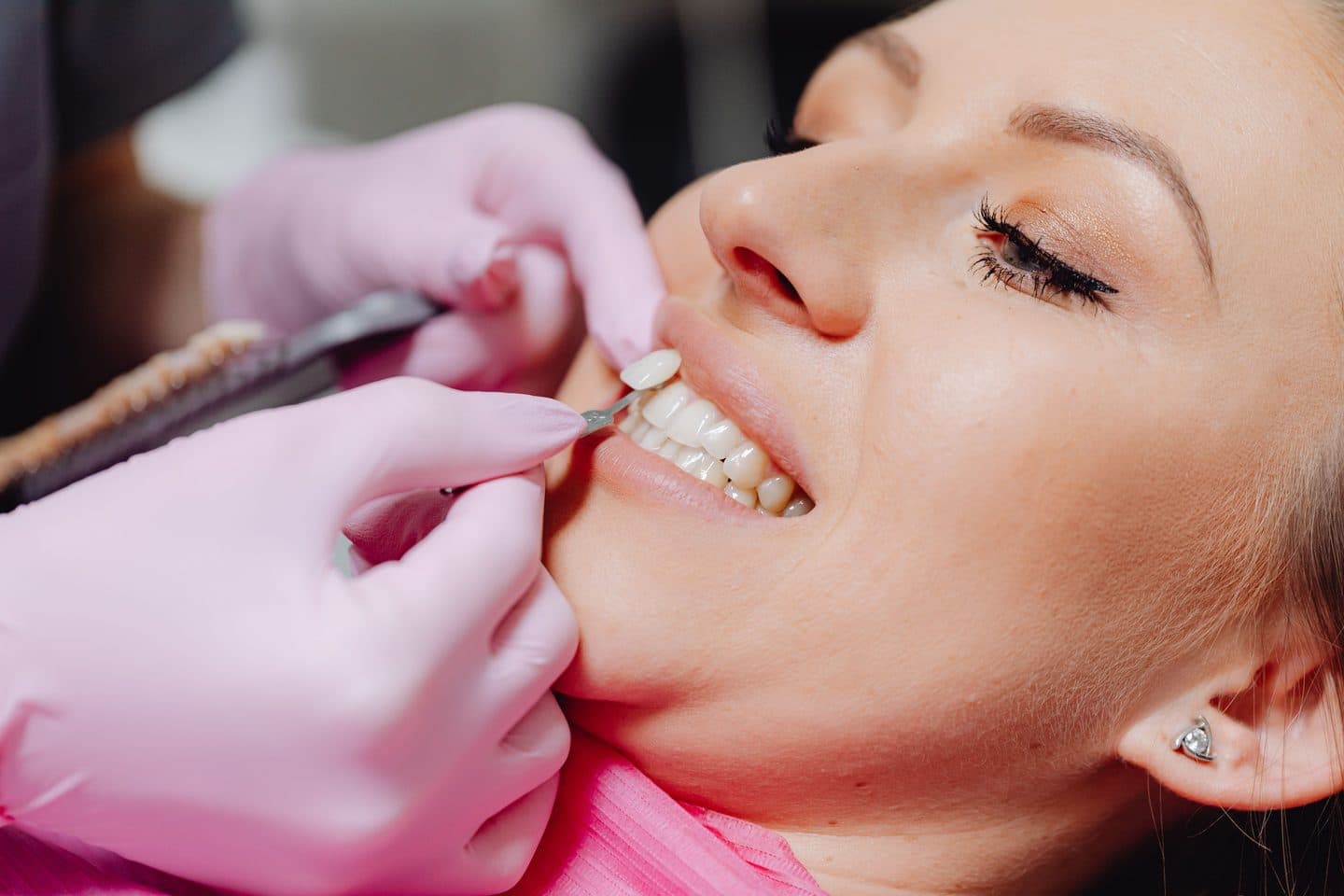
One important step in the veneer process is choosing the right shade. Using a standard shade guide, the dentist evaluates your teeth's current color, the tone of neighboring teeth, and your overall smile goals together. The aim is a natural-looking result where the veneers match both each other and the surrounding natural teeth.
This step matters especially when a veneer is being placed on a single tooth — if that one veneer's shade differs noticeably from the neighboring teeth, the result can end up looking unnaturally out of place.
How Does the Process Work?
For porcelain veneers, the process generally goes: the dentist removes a small amount of enamel, takes an impression or a digital scan, sends that data to a lab where the veneer is custom-fabricated, and then bonds the finished veneer to the tooth and checks the fit.
Composite veneers follow a different process: the material is shaped directly on the tooth and hardened with a special light — a faster process that's usually completed in a single appointment.
What Does Aftercare Look Like?
The ADA recommends a few basic care points: avoiding hard foods, wearing a mouthguard during sports, limiting dark, staining beverages, brushing twice a day with fluoride toothpaste, and flossing regularly.
These may sound like general oral care advice, but they matter especially with veneers — the veneer itself can't decay, but the natural tooth structure underneath it and the veneer's edges still need care.
Why Is This a Hard Decision to Reverse?
Honesty matters here: according to the ADA, traditional veneer treatment is not reversible, because it involves removing some tooth enamel — a tissue the body can't regenerate. That makes this a decision that shouldn't be taken lightly.
That's why it makes sense, as a first step, to evaluate whether a less invasive alternative like teeth whitening would genuinely be enough before considering veneers. Composite veneers, since they require little or no enamel removal, stand out as a relatively more "reversible" option in this respect.
How Durable Are Veneers?
A 2021 systematic review in the Journal of Clinical Medicine analyzed 25 clinical studies spanning 1997-2020 and a total of 6,500 porcelain veneers. The result: the 10-year overall survival rate, accounting for fracture, debonding, secondary decay, and the need for root canal treatment together, was 95.5% (Alenezi A, et al., Journal of Clinical Medicine, 2021).
Broken down by individual cause, the 10-year survival rates were: 96.3% when fracture alone was the failure criterion, 99.2% for debonding, 99.3% for secondary decay, and 99.0% for needing root canal treatment. Non-feldspathic porcelain veneers (newer-generation ceramic materials) performed statistically significantly better than feldspathic ones (traditional porcelain).
The review also had a design-related finding: veneer designs that also covered the incisal edge lasted longer than designs that didn't. That means the veneer's design itself is a factor that affects the outcome — in other words, "the right material plus the right design" is a package that needs to be considered together.
A Warning: Unlicensed "Veneer Technicians"
The ADA flags a growing concern: cases of people without a dental license presenting themselves as "veneer technicians" and applying veneers with no professional supervision. The ADA warns that this kind of practice can lead to serious complications, including infection risk and nerve damage.
This is one more reason choosing the right dentist matters — I covered this in more detail in "How to Choose a Dentist."
A Single Tooth, or Part of a Bigger Plan?
A veneer can be applied on its own to resolve an isolated cosmetic issue on a single tooth, or it can be considered as part of a broader smile design plan spanning multiple teeth — especially when planned together with other treatments like teeth whitening or gum aesthetics.
Which approach — a single tooth, multiple teeth, or combined with other treatments — fits your situation depends on your expectations and the overall condition of your teeth, and becomes clear during an exam.
Bottom Line
In the right case, veneers can deliver reliable, evidence-backed results. But they're not the right fix for every dental concern, and because the decision is hard to reverse, it deserves to be taken seriously. The only way to find out whether you're a good candidate, and which material suits you best, is through an exam.
Frequently Asked Questions
Is getting veneers painful?
The procedure is usually done under local anesthesia; mild sensitivity may be felt afterward.
What's the difference between a veneer and a crown?
A veneer covers only the front surface of the tooth, while a crown wraps around the entire tooth — which is why crowns usually require more tooth reduction.
Do veneers replace teeth whitening?
No, they serve different purposes; veneers can be considered when discoloration doesn't respond to whitening, but they don't substitute for it.
Is composite or porcelain better for me?
This depends on your expectations, budget, and the condition of your teeth; the trade-offs of each option are weighed together during an exam.
I have bruxism — can I still get veneers?
Bruxism can damage veneers over time; in this situation, it's recommended to bring the bruxism under control first, then evaluate whether veneers are a suitable option.
How many years do veneers last?
According to the evidence, porcelain veneers have a roughly 95.5% 10-year survival rate — though this can vary based on your oral care and habits.
Are veneers done for a single tooth or multiple teeth?
Either is possible — a veneer can be applied for an isolated issue on a single tooth, or included as part of a smile design plan spanning multiple teeth.
Does the shade of a veneer change over time?
Porcelain veneers are highly stain-resistant and generally keep their shade for a long time; composite veneers can show slight discoloration over time.